
Pavillon Yuasa
Restaurant gastronomique japonais à Bordeaux
Wagyu, Kobe Beef and A5: A Guide to Japanese Beef
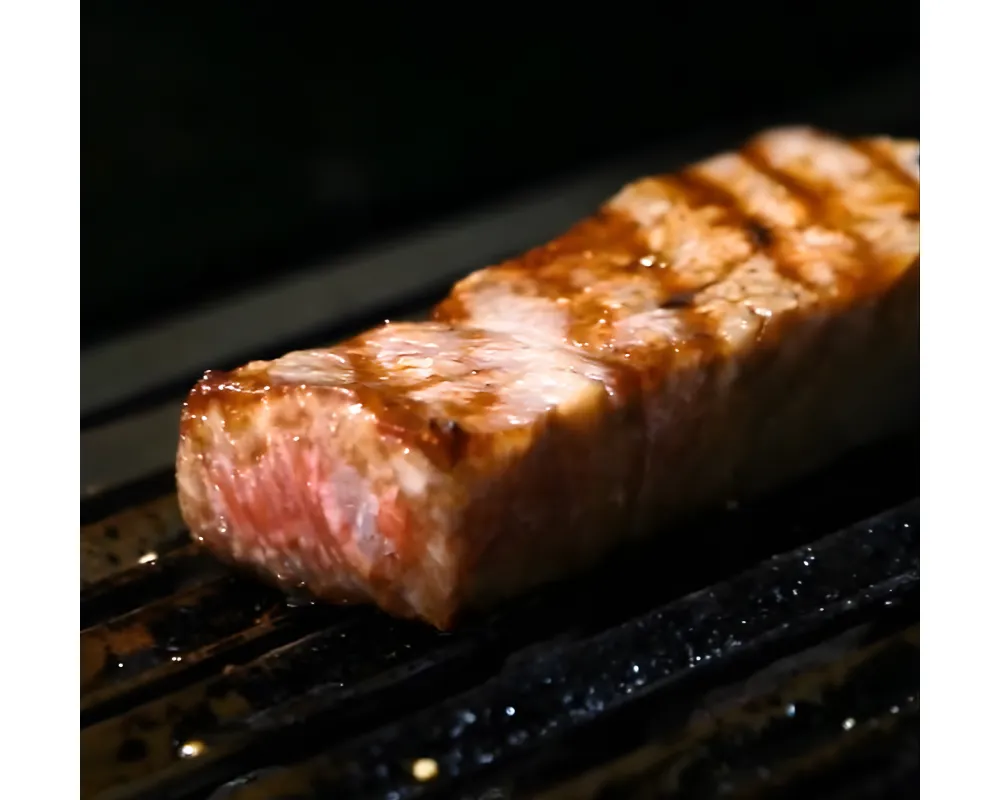
The word “wagyu” is everywhere on menus these days, usually alongside “Kobe beef” and the letters “A5”. The three terms do not mean the same thing: the first is a group of cattle breeds, the second a regional appellation, the third a grade given to the carcass. Here is what each one means, and what it changes on the plate.
Wagyu does not mean Kobe beef
Wagyu (和牛) literally means “Japanese cattle”. The term covers four breeds recognised in Japan: Japanese Black (kuroge washu), which accounts for the vast majority of the herd, Japanese Brown, Japanese Shorthorn and Japanese Polled. Kobe beef is not a breed but an appellation: cattle of Tajima bloodline, raised in Hyōgo prefecture and meeting a strict set of criteria. Kobe is therefore one wagyu brand among several, alongside Matsusaka, Ōmi and Yonezawa.
How to read the A5 grade
The grade has two parts. The letter — A, B or C — expresses the meat yield of the carcass, A being the highest. The number — 1 to 5 — rates meat quality against four criteria assessed separately: marbling, meat colour and brightness, firmness and texture, and the colour and quality of the fat. The final grade is the lowest of the four. An A5 is therefore a high-yield carcass that scores top marks on all four counts at once.
One point deserves emphasis: A5 is not a taste score. It is an assessment of the carcass, made before any cooking, and it says nothing about the animal’s age, its feed, or the cook’s work. A well-chosen, well-cooked A4 cut can be more enjoyable than an A5 served in too generous a portion.

Marbling, or why wagyu melts in the mouth
Marbling — sashi in Japanese — is the fine web of fat running through the muscle. It is measured on a dedicated scale, the BMS, from 1 to 12; A5 corresponds to the upper end of that scale. This intramuscular fat has one distinctive property: its melting point is markedly lower than that of European beef fat, at around 25 to 30 °C. It therefore begins to melt at mouth temperature, which explains the sensation of meat that yields almost without effort.
Why wagyu is eaten in small quantities
This follows directly from the marbling. Wagyu is rich, and beyond a few bites the palate saturates. In Japan, wagyu is therefore rarely served as a 300-gram steak. Instead the meat is cut thin and seared quickly, or portioned into bite-sized pieces. The rule fits in one line: less, but better. It is also what makes wagyu suited to a multi-course menu, where it takes up a single course rather than the whole meal.

Sumibi-yaki: charcoal rather than a pan
Sumibi-yaki means cooking over Japanese charcoal. The radiant heat is intense and dry: the surface colours quickly, while fat dripping onto the embers produces a light smoke that perfumes the meat. Compared with pan-searing, the cut loses less moisture and keeps a suppler texture. For something as fatty as wagyu, this is the method that best brings out the contrast between crust and centre. See also: Wagyu Sumibiyaki.

Wagyu as sushi
Wagyu also works as sushi, provided it is treated as a fatty fish rather than as meat. The slice is thin, briefly seared or flame-kissed, then set on still-warm vinegared rice. The contrast between melting fat and the acidity of the rice takes over the role usually played by the fat of the fish. It is a recent preparation by the standards of sushi history, but one that has settled into Japanese counters. See also: Wagyu sushi in Bordeaux.
Why wagyu is expensive
Three main reasons. Fattening is long: the animals are raised far longer than in European beef systems, on a grain-rich diet. Selection is strict: only a share of carcasses reaches the top grades. And for a European restaurant, the constraints of importing from Japan are added on top. The price reflects not merely scarcity but an entire way of raising cattle. See also: Discover the finesse of wagyu.
Wagyu at Pavillon Yuasa, Bordeaux
In the Chartrons district, chef Junichi Yamano serves wagyu in two ways. The Wagyu Sumibi-Yaki menu (€95) is a six-course menu combining wagyu sushi with a cut grilled over Japanese charcoal. The Sushi Kaiseki menu (€95) brings wagyu into the second run of sushi, after a first run devoted to fish and shellfish. The Omakase menu (€65) remains built around seasonal fish. Service is at the counter, each piece prepared in front of you, Tuesday to Saturday from 7:30 pm. The dining room is fully air-conditioned and reservations are made online. See also the full menu.
What is the difference between wagyu and Kobe beef?
Wagyu refers to four Japanese cattle breeds. Kobe beef is an appellation: cattle of Tajima bloodline raised in Hyōgo prefecture and meeting strict criteria. All Kobe beef is wagyu; not all wagyu is Kobe beef.
What exactly does A5 mean?
The letter A is the highest carcass yield grade; the number 5 is the highest meat quality grade, assessed on marbling, colour, texture and fat quality. The grade awarded is the lowest of the scores obtained across those four criteria. A5 is not a taste score.
Why does wagyu melt in the mouth?
Because its intramuscular fat has a low melting point, around 25 to 30 °C — below mouth temperature. It starts to melt from the first bite.
How much wagyu should be served?
Not much. Wagyu is rich: a few bites are enough to appreciate the texture, and too large a portion saturates the palate. That is why it is served in thin slices or bite-sized pieces, within a multi-course menu.